

Strength training men over 40 produces measurable muscle growth when programs account for recovery needs and joint protection. Men in their 40s, 50s, and early 60s can build and maintain significant muscle mass through structured resistance training and functional improvements when programs account for recovery needs and joint protection strategies. This 8-week training framework uses a 4-day split system with progressive loading, emphasizing controlled volume and joint-friendly movement patterns. The approach prioritizes sustainable strength development over short-term intensity, designed specifically for men managing age-related recovery constraints while targeting realistic muscle-building outcomes.

What This Program Covers (and What It Doesn’t)
This framework addresses structured resistance training for men ages 40-60 who want to build or maintain muscle mass safely. The program includes four distinct training days (push, legs, pull, full-body), progressive rep schemes, and strategic cardio integration. It does not include sport-specific conditioning, advanced periodization models, or rehabilitation protocols for existing injuries.
The 8-week duration allows enough exposure to assess individual response patterns without requiring long-term commitment before evaluation. Men with preexisting joint issues, cardiovascular conditions, or recent surgeries should consult medical providers before starting structured resistance programs.


Key Training Principles for Strength Training Men Over 40
Progressive Loading Without Training to Failure
Observed training patterns show that men over 40 respond better to reps-in-reserve strategies than consistent training to muscular failure. Each set stops 1-2 repetitions before complete exhaustion, reducing cortisol response and cumulative fatigue while still providing sufficient stimulus for adaptation.
Recovery-First Scheduling
The program alternates training days with rest periods, allowing 48-72 hours between sessions targeting the same muscle groups. This recovery window addresses the longer restoration timelines common in men past 40, where tissue repair mechanisms operate less efficiently than in younger populations.
Joint Protection Through Movement Selection
Exercise choices favor angles that minimize shoulder impingement risk, reduce lumbar compression, and avoid excessive knee shear forces. Incline pressing movements replace flat bench variations, Romanian deadlifts substitute conventional pulls, and machine-based options supplement free weight work.
Quick Summary
- Stop sets 1-2 reps before failure to manage fatigue
- Allow 48-72 hours between training the same muscles
- Choose movements that reduce joint stress
The 4-Day Strength Training Split for Men Over 40
Push Day Structure
In a program built for strength training men over 40, upper body pressing movements must protect the anterior shoulders. Upper body pressing movements for chest, shoulders, and triceps. The session uses incline angles for chest work (reducing anterior shoulder stress), machine-based shoulder pressing (controlling scapular movement), and cable-based tricep extensions (maintaining constant tension). Four exercises complete the session, each performed for 4 sets with descending rep schemes (12, 10, 8, 6) that allow progressive weight increases.
Leg Day Approach
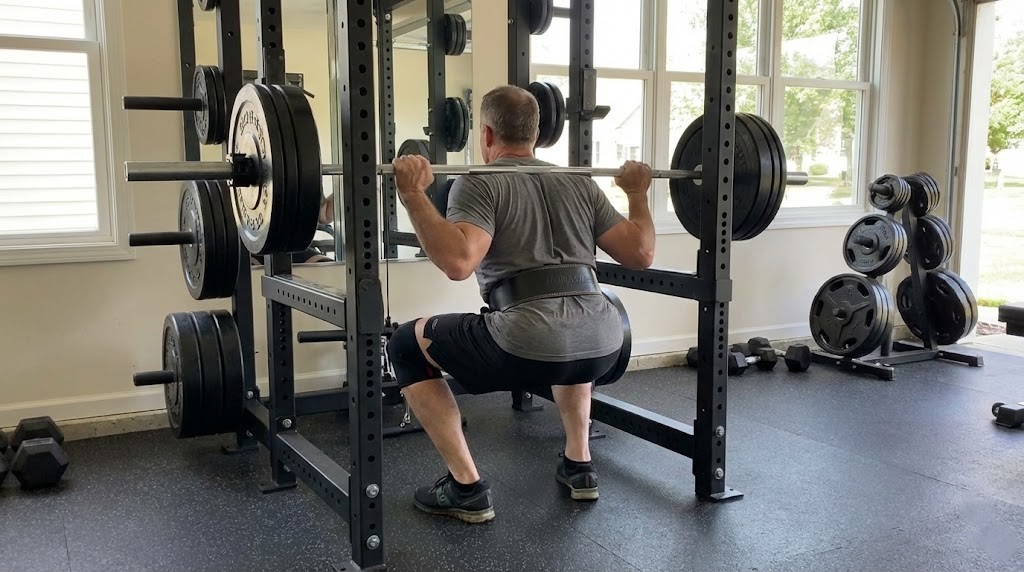
Lower body sessions in strength training men over 40 emphasize higher rep ranges to build capacity without excessive joint wear. Lower body training emphasizes higher rep ranges (20, 15, 10, 10) to build work capacity while managing joint loading. The sequence moves from compound movements (squats, leg press) to isolation (extensions, curls), finishing with calf work. This rep structure reduces the need for extremely heavy loads that increase injury risk.
Pull Day Organization
Deadlifts and rows provide essential posterior chain stimulus during strength training men over 40. Back and bicep training through rowing patterns, vertical pulls, and direct arm work. Deadlifts open the session when energy levels peak, followed by unilateral rowing (addressing strength imbalances), wide-grip pulldowns (lat emphasis), and posterior shoulder work before moving to bicep-focused movements.
- 10 exercise rows with 4 sets each
- Notes column for each exercise
- Session check for warm-up, form, energy and sleep
Instant download • 100% free • No email required
Full Body Integration
The final session integrates full-body movements crucial for strength training men over 40. The fourth session uses moderate volume across all major muscle groups with consistent rep targets (3 sets of 10-15 reps). This session supports metabolic work, addresses movement patterns not heavily loaded in other sessions, and includes core training often neglected in traditional splits.
Who This Approach Works Best For
This program serves men 40-60 with the following characteristics:
Training Background: Beginners to intermediate lifters who can learn compound movement patterns with proper form. Prior strength training experience helps but isn’t required if movement coaching is available.
Time Availability: 60-90 minutes per session, 4 days weekly. The split requires consistent adherence—missing sessions disrupts the balance between muscle groups and reduces program effectiveness.
Health Status: Generally healthy individuals without severe joint degeneration, uncontrolled cardiovascular conditions, or recent musculoskeletal injuries. Men managing chronic conditions should verify program compatibility with healthcare providers.
Equipment Access: Standard commercial gym equipment including barbells, dumbbells, cable stations, and basic machines. Home gym adaptations are possible but require equivalent loading options.
This approach is not designed for men seeking maximum strength development (powerlifting focus), those with significant movement restrictions, or individuals unable to maintain 4-session weekly frequency.
Common Limitations in Strength Training Men Over 40
Recovery Demands May Exceed Expectations
Men transitioning from sedentary patterns often underestimate post-workout recovery needs. Muscle soreness typically peaks 24-48 hours after sessions (delayed onset muscle soreness) and can temporarily affect daily function. Sleep requirements may increase, and energy levels may dip during the first 2-3 weeks of program initiation.
Joint Response Varies Significantly
Some men experience immediate joint relief from controlled loading, while others notice increased discomfort in shoulders, knees, or lower back. Movement modifications (changing grip width, adjusting foot position, reducing range of motion) often resolve issues, but persistent pain signals the need for exercise substitution or professional assessment.
Strength Gains Occur Faster Than Physique Changes
Visible muscle development typically lags behind strength improvements by 4-6 weeks. Neural adaptations and technique refinement drive early progress, while structural changes (muscle fiber growth) require longer exposure. This timeline can create unrealistic expectations if men expect rapid physical transformation.
Cardiovascular Capacity May Limit Initial Performance
Men with minimal recent aerobic activity may find work capacity, not muscle fatigue, limits their training sessions. Breathlessness between sets and elevated heart rate during resistance work indicates cardiovascular conditioning gaps that improve with consistent training and strategic cardio addition.
How to Start and Stay Consistent
Consistency and patience form the true foundation of successful strength training men over 40. Begin with conservative weight selection on all movements—choose loads that feel manageable for the highest rep targets, even if this means starting lighter than expected capabilities suggest. Record all weights, sets, and reps to track progression objectively rather than relying on subjective effort perception.
Schedule training sessions at consistent times to establish behavioral patterns. Morning sessions before work obligations often show higher completion rates than evening plans that compete with fatigue and schedule changes. Prepare gym bags the night before and minimize decision-making barriers.
Add 3-4 cardio sessions weekly (20-30 minutes each) using low-impact modalities like walking, cycling, or rowing. Extended cardio sessions can interfere with muscle recovery and compete for caloric resources, making shorter, more frequent sessions preferable for men prioritizing muscle development.
Monitor recovery indicators including sleep quality, resting heart rate, and movement soreness patterns. Persistent fatigue, declining performance, or unusual joint discomfort signals the need for extra rest days or program modification.
After completing the 8-week cycle, assess whether to repeat the program with heavier loads, transition to a different split structure, or adjust training frequency based on recovery patterns and progress outcomes. Most men benefit from 2-3 cycles of the same framework before making structural changes, as familiarity with movements improves execution quality and allows better progression tracking.
Strength training men over 40 produces reliable results when programs account for realistic recovery timelines, emphasize joint protection, and avoid the intensity traps that create unsustainable approaches. Consistency across months matters more than perfection within individual sessions.
- 10 exercise rows with 4 sets each
- Notes column for each exercise
- Session check for warm-up, form, energy and sleep
Instant download • 100% free • No email required