

Reformer pilates for women offers a unique approach to controlled strength development without high joint stress. The reformer machine intimidates first-time users—the springs, straps, and sliding carriage look more mechanical than therapeutic. Yet this method consistently ranks among the most requested workouts by women seeking functional fitness improvements.
This guide examines reformer pilates mechanics, observable adaptations from consistent practice, and practical considerations for women starting this training method. The focus remains on what the equipment does, how the body responds, and who benefits most from this approach.
What Reformer Pilates for Women Actually Is
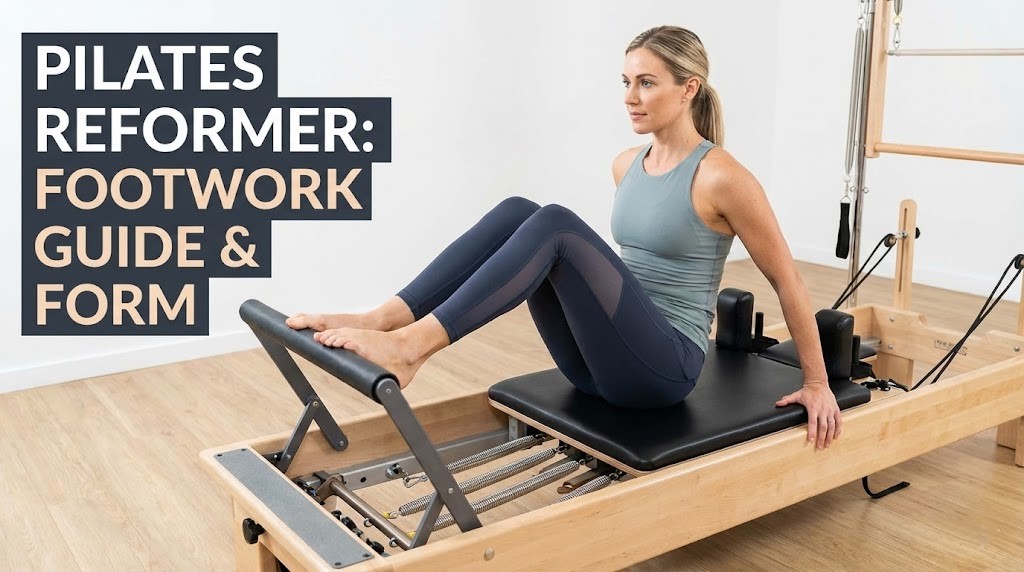
Reformer pilates uses a sliding platform attached to springs of varying resistance. The carriage moves along rails while the user performs controlled movements against spring tension. Unlike mat pilates, which relies on body weight and gravity, the reformer adds external resistance that adjusts based on spring selection and body position.

- 8 stretches with hold times
- About 10 minutes, after a workout or before bed
- Simple safety rules for every stretch
Instant download • 100% free • No email required
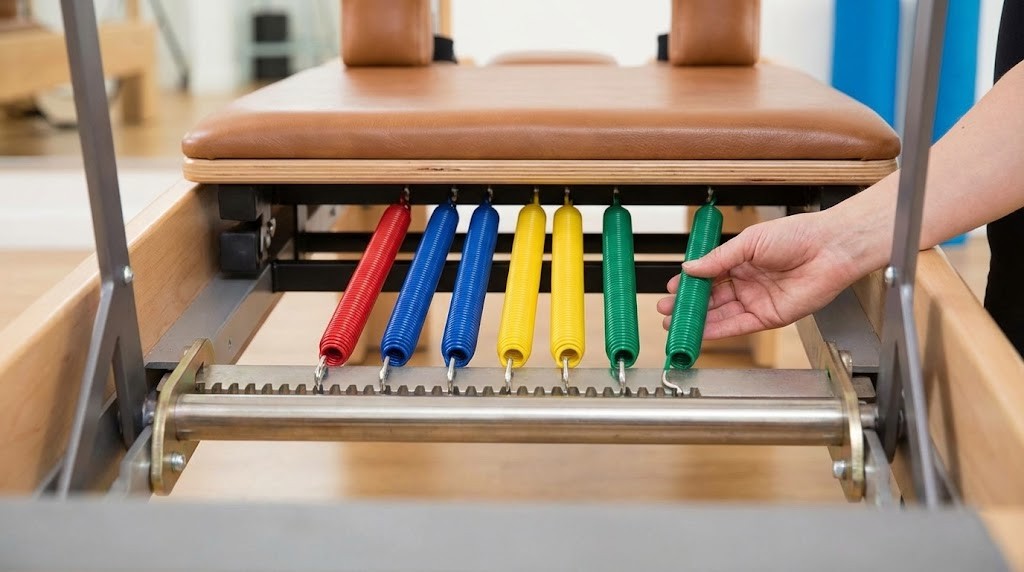
The machine consists of five main components: the carriage (sliding platform), springs (resistance source), foot bar (anchor point), shoulder blocks (positioning guides), and straps (handles for arms and legs). Spring tension ranges from light to heavy, allowing progressive resistance adjustment without changing equipment.
Movement patterns emphasize eccentric control—the lengthening phase of muscle contraction. This occurs when the carriage returns to start position against spring resistance. The machine forces deceleration control, which differs fundamentally from momentum-based training.
Core engagement remains constant throughout reformer work. The unstable carriage surface requires continuous stabilization, activating deep trunk muscles that maintain spinal position. This differs from isolated core exercises where abdominal engagement occurs only during specific movements.
Reformer vs. Mat Pilates: Fundamental Differences
Mat pilates works against gravity and body weight. Exercises like the hundred or roll-up challenge core strength through fixed positions. Progression occurs by increasing repetitions or holding positions longer.
Reformer pilates modifies resistance through spring adjustment and carriage position. A single exercise—such as footwork—can range from rehabilitation-level resistance to advanced strength work simply by changing spring combinations. This makes the reformer more adaptable for varying fitness levels within the same exercise framework.
The reformer provides proprioceptive feedback through spring resistance. Users feel when they lose control because the carriage movement becomes jerky or uneven. Mat work offers less immediate feedback about movement quality, particularly for beginners who lack body awareness.
Range of motion differs significantly. The reformer’s straps and foot bar create resistance through full movement arcs, including ranges impossible to achieve with body weight alone. Exercises like leg circles or chest expansion maintain tension throughout the entire motion, whereas mat variations lose resistance at certain angles.
Key Distinction: Mat pilates builds relative strength (managing your own body weight), while reformer pilates develops absolute strength (managing external resistance) with greater control over intensity progression.
Observable Benefits of Reformer Pilates for Women
Women who maintain regular reformer practice typically observe postural changes before strength improvements. Shoulder positioning shifts as upper back muscles counterbalance forward shoulder posture common from desk work. This appears as increased space between the shoulder blades and reduced neck tension.
Muscle definition patterns differ from traditional resistance training. Reformer work emphasizes muscle lengthening under tension, which tends to create longer-appearing muscle bellies rather than concentrated bulk. The legs particularly show this pattern—observable tone without significant size increase.
Core engagement becomes automatic in daily activities. Long-term practitioners report unconscious trunk stabilization during non-exercise movements like carrying groceries or reaching overhead. This reflects neuromuscular adaptation where stabilization patterns trained on the reformer transfer to functional movement.
Hip and shoulder mobility typically improves within 8-12 weeks of consistent practice. The reformer’s assisted range of motion work—where springs support movement rather than resist it—helps develop flexibility without forcing end ranges. Users often notice easier overhead reaching or deeper squatting patterns.
Lower body symmetry issues become apparent on the reformer. The independent foot bar work reveals strength imbalances between legs that compensatory patterns hide in daily movement. Addressing these imbalances may reduce knee and hip discomfort over time, though individual responses vary.
Warning Box: Postural Adaptation Reality Reformer pilates does not “fix” posture automatically. Observable changes require 3-6 months of consistent practice (2-3x weekly minimum) plus conscious posture awareness outside the studio. Women with significant structural issues (scoliosis, hyperkyphosis) may see limited postural change without additional intervention. The reformer provides tools for improvement, not guaranteed correction.
Reformer Pilates Benefits: Evidence-Based Observations
Controlled Strength Development Without Impact
The reformer’s spring resistance allows progressive loading without joint compression. Footwork exercises build leg strength through pushing against springs rather than landing forces from jumping or running. This makes the training method viable for women with:
- Knee arthritis or previous injuries
- Hip impingement or labral issues
- Ankle instability or chronic sprains
- Bone density concerns requiring low-impact options
Spring resistance creates constant tension throughout movement, which differs from free weight training where resistance changes with joint angle. This consistent loading pattern develops strength across full range of motion rather than just at specific points.
Trunk Stability Transfer to Daily Function
The unstable carriage surface requires continuous core engagement to maintain position. This trains the trunk stabilizers under dynamic conditions that more closely mirror daily movement than static planks or crunches.
Women report improved stability during:
- Single-leg balance tasks (stairs, uneven terrain)
- Rotational movements (reaching across the body)
- Loaded carries (grocery bags, child carrying)
- Sustained sitting positions (desk work)
This functional transfer occurs because reformer exercises combine trunk stabilization with limb movement—the same coordination required for most daily activities.
Hip and Shoulder Mobility Enhancement
The reformer facilitates assisted stretching where springs support movement rather than resist it. This differs from traditional stretching, which relies on body weight or external pressure to increase range of motion.
Exercises like mermaid (lateral trunk flexion) or splits (hip flexion/extension) use spring assistance to explore end ranges without forcing tissue beyond comfortable limits. The resistance on the return movement then strengthens muscles through their new available range.
Women with desk-dominant lifestyles particularly benefit from:
- Thoracic extension exercises (countering rounded upper back)
- Hip flexor lengthening (addressing anterior pelvic tilt)
- Shoulder external rotation work (reversing internal rotation bias)
Pelvic Floor Awareness and Control
Reformer footwork and leg circles require pelvic stability against moving springs. This creates natural pelvic floor engagement without isolated contraction exercises. The proprioceptive feedback from spring resistance helps women identify when pelvic floor muscles activate versus when they compensate with glutes or hip flexors.
This awareness proves valuable for women experiencing:
- Post-pregnancy core reconnection challenges
- Stress urinary incontinence during exercise
- Difficulty identifying pelvic floor muscle engagement
- Coordination issues between breathing and core activation
Warning Box: Pelvic Floor Limitations Reformer pilates does not substitute for pelvic floor physical therapy when dysfunction exists (significant incontinence, prolapse symptoms, pelvic pain). The equipment provides general awareness training, not therapeutic intervention. Women with diagnosed pelvic floor disorders should consult specialized physical therapists before beginning reformer work, as certain exercises may worsen symptoms if performed incorrectly.
Breathing Pattern Improvement
Reformer exercises coordinate movement with breath—typically exhaling during exertion and inhaling during return phases. This structured breathing pattern trains diaphragmatic breathing under physical load, which many women lose during stress or desk work.
The chest expansion exercise specifically targets thoracic mobility during inhalation, helping reverse shallow breathing patterns. Spring resistance on the arms during inhalation encourages fuller rib expansion than occurs naturally.
What to Expect: First Reformer Pilates Session Reality
The reformer carriage moves faster than anticipated. First-time users frequently lose control during return phases because they expect more friction. The springs accelerate the carriage back to start position if not actively controlled, which feels unstable initially.
Muscle fatigue appears in unexpected locations. Women accustomed to traditional strength training report burning sensations in:
- Inner thighs during footwork (not typically targeted in gym exercises)
- Upper back between shoulder blades (from maintaining shoulder position)
- Deep abdominals below the navel (distinct from rectus abdominis burn)
- Lateral hip muscles during side-lying work
This fatigue pattern reflects the reformer’s emphasis on stabilizers and eccentric control rather than prime movers and concentric strength.
Coordination challenges exceed strength demands initially. Learning to push the carriage while maintaining spinal position and coordinating breath creates cognitive load before muscular failure occurs. This improves rapidly—most women report significant coordination improvement within 3-4 sessions.
Post-session soreness manifests differently than weight training soreness. The delayed onset muscle soreness (DOMS) tends to be more diffuse and less intense, appearing 24-48 hours after the session. This reflects the eccentric-dominant nature of reformer work, which causes less muscle trauma than heavy concentric loading.
The pace feels slower than group fitness classes. Reformer sessions involve setup time between exercises and frequent form adjustments. Women expecting high-intensity interval training energy may find the controlled pace underwhelming initially, though muscle fatigue accumulates throughout the session.
Bottom Line Your first reformer session will likely feel unstable, target unexpected muscle groups, and progress slower than traditional workouts. This does not indicate ineffectiveness—it reflects the movement patterns and control demands unique to spring-based resistance training.
Reformer Pilates for Beginners: Essential Starting Framework
Week 1-2: Equipment Familiarization and Basic Spring Resistance
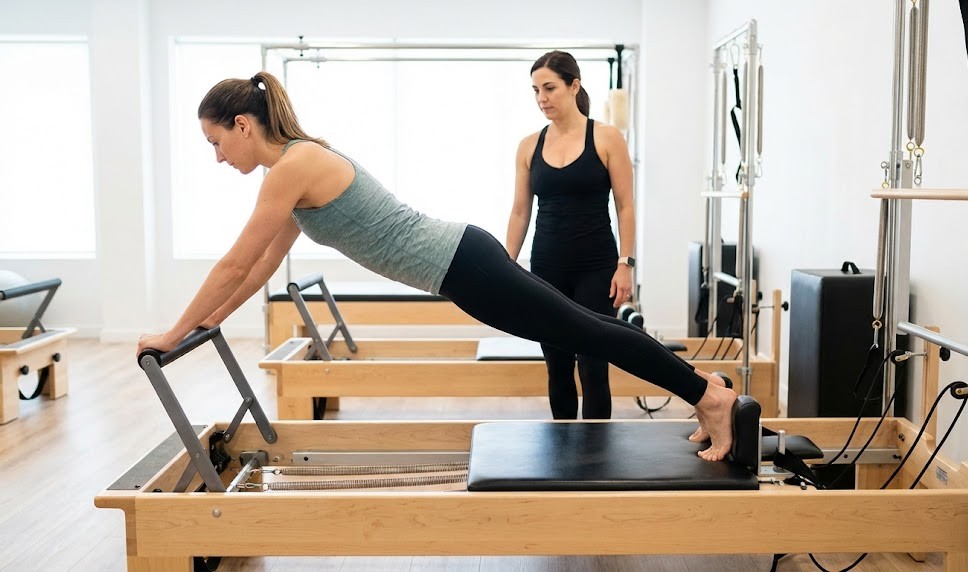
Begin with fundamental footwork variations to establish carriage control:
- Position feet on the foot bar with heels together, toes apart (Pilates V stance)
- Push the carriage away by straightening legs while maintaining neutral spine
- Control the carriage return by resisting spring pull through eccentric quadriceps engagement
- Repeat for 8-10 repetitions, focusing on smooth acceleration and deceleration
Start with one light spring or two light springs maximum. The carriage should move smoothly without jerking or banging at either end of the range.
Warning Box: Footwork Form Errors Common mistakes include: (1) allowing knees to collapse inward during return phase, creating knee stress, (2) losing spinal neutral by arching lower back when pushing carriage away, (3) locking knees at full extension, transferring load from muscles to joint structures, and (4) rushing return phase, which eliminates eccentric training benefit. If you cannot control the return smoothly, reduce spring resistance immediately.
Week 3-4: Trunk Stabilization Under Movement
Progress to exercises requiring carriage control while moving limbs independently:
Supine Arm Work
- Lie on carriage with head at foot bar end, holding straps
- Extend arms toward ceiling with palms facing forward
- Pull straps down toward hips while maintaining rib contact with carriage
- Return arms overhead with controlled resistance
- Perform 8-10 repetitions without allowing ribs to lift from carriage surface
Spring resistance should allow smooth arm movement without shoulder hiking or neck tension. Typically 1-2 light springs for beginning arm work.
Warning Box: Shoulder Stabilization Failures Watch for: (1) shoulders elevating toward ears as arms move, indicating overload or compensatory neck muscle use, (2) ribs lifting from carriage, showing loss of core engagement, (3) uneven arm movement where one side moves faster than the other, revealing strength imbalances, and (4) breath-holding, which creates core rigidity rather than controlled stabilization. Reduce spring resistance if any of these occur consistently.
Week 5-8: Coordination and Breath Integration
Introduce exercises combining multiple joints and breath patterns:
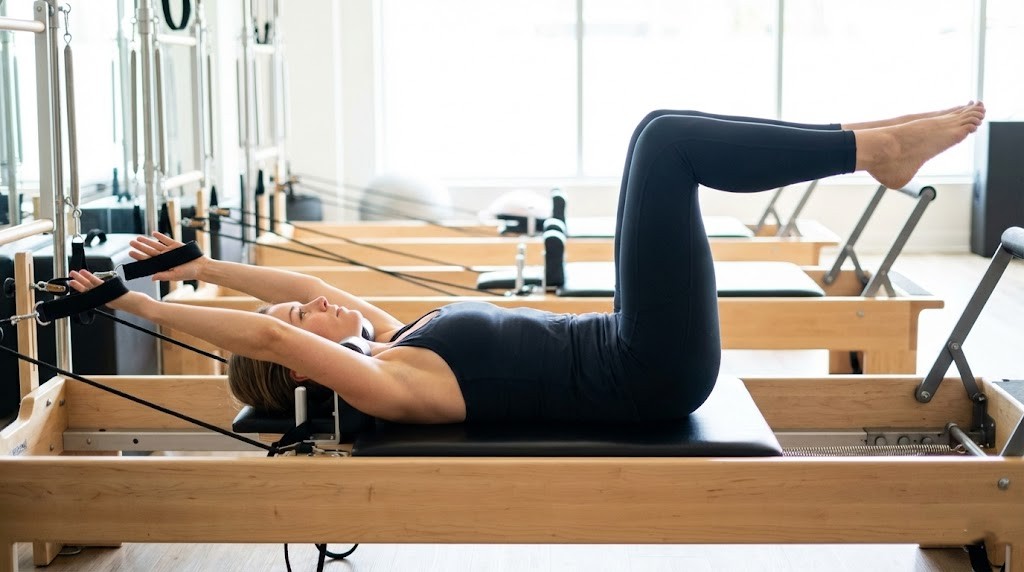
Coordination Exercise
- Lie supine holding straps with knees bent, feet lifted
- Extend arms and legs simultaneously while exhaling
- Open and close legs while maintaining arm and core position
- Return to start position while inhaling
- Complete 6-8 repetitions with smooth breath coordination
This exercise challenges the ability to maintain trunk stability while moving both arms and legs in coordinated patterns.
Warning Box: Coordination Breakdown Patterns Beginners commonly: (1) hold breath during leg opening/closing, creating core rigidity and missing the movement control challenge, (2) lose trunk stability when legs open, allowing lower back to arch, (3) bend elbows when legs move, indicating insufficient core support for maintaining multiple positions, and (4) rush through movements to avoid the stabilization demand. If coordination deteriorates, return to simpler exercises rather than pushing through with poor control.
Progression Markers: When to Advance
Do not progress to intermediate exercises until you can:
- Complete 10 repetitions of basic footwork with smooth control
- Maintain neutral spine throughout arm work without rib lift
- Coordinate breath with movement without holding or gasping
- Identify when you lose control (carriage jerking, uneven movement)
- Perform exercises on both sides with similar difficulty level
Beginners typically require 8-12 sessions before meeting these markers consistently. Attempting advanced exercises prematurely increases injury risk and reinforces compensatory movement patterns.
How Often Should You Do Reformer Pilates: Frequency and Recovery
Minimum Effective Frequency: 2 Sessions Per Week
Observable adaptation requires consistent neuromuscular training. Two weekly sessions spaced 2-4 days apart allow:
- Movement pattern consolidation between sessions
- Recovery from eccentric muscle loading
- Progressive resistance adjustment without overtraining
Women training once weekly typically report enjoying sessions but observe minimal functional transfer or strength improvement. The practice becomes recreational rather than adaptive.
- 8 stretches with hold times
- About 10 minutes, after a workout or before bed
- Simple safety rules for every stretch
Instant download • 100% free • No email required
Optimal Frequency: 3 Sessions Per Week
Three weekly sessions create sufficient training stimulus for measurable strength and control improvements. This frequency allows:
- Progressive spring resistance increases every 2-3 weeks
- Adequate recovery between sessions (minimum 48 hours)
- Skill retention that builds session-to-session rather than relearning basics
Women maintaining 3x weekly practice for 12+ weeks typically report the functional benefits discussed earlier—improved posture awareness, reduced discomfort during daily movement, observable muscle tone changes.
Advanced Frequency: 4+ Sessions Per Week
Four or more weekly sessions suit women specifically training for movement-related goals:
- Dancers maintaining control and flexibility
- Athletes using reformer for injury prevention
- Post-rehabilitation progression from physical therapy
This frequency requires careful programming to prevent overtraining. Same-muscle-group exercises should not occur on consecutive days. Advanced frequency typically alternates between upper-body-focused, lower-body-focused, and full-body sessions.
Warning Box: Overtraining Indicators Excessive reformer frequency without adequate recovery causes: (1) persistent muscle soreness lasting 3+ days after sessions, (2) loss of movement control on exercises previously mastered, indicating neuromuscular fatigue, (3) increased irritability or sleep disturbance from chronic low-grade stress, and (4) decreased motivation or enjoyment during sessions. If these appear, reduce frequency to 2-3x weekly for 2 weeks before considering progression.
Recovery Considerations Specific to Reformer Training
Eccentric-dominant exercise (controlling the carriage return against springs) creates more muscle microtrauma than concentric work. This requires longer recovery than metabolic fatigue from cardiovascular exercise.
Women should note:
- Soreness peaks 48-72 hours post-session (later than typical gym soreness)
- Training the same muscle groups on consecutive days limits adaptation
- Light movement (walking, swimming) on off-days enhances recovery
- Adequate protein intake (0.7-1.0g per pound body weight) supports tissue repair
Active recovery activities that complement reformer work include:
- Walking or light cycling (promotes blood flow without eccentric loading)
- Swimming (provides mobility work without impact)
- Foam rolling or massage (addresses muscle tension accumulation)
Avoid combining reformer training with high-intensity interval training or heavy strength work on the same day. The neurological fatigue from controlled reformer movements impairs performance in power-based activities, while the metabolic fatigue from intense cardio reduces movement control quality needed for reformer work.
Who Benefits Most from Reformer Pilates
Women with Joint Limitations or Previous Injuries
The reformer’s spring resistance allows strength development without compressive forces. This suits women experiencing:
Knee Issues
- Patellofemoral pain from running or high-impact activity
- ACL reconstruction rehabilitation (later stages with clearance)
- Arthritis limiting load-bearing exercise tolerance
- Meniscus injuries requiring strength maintenance without aggravation
The horizontal carriage position removes gravitational load from knee joints while spring resistance maintains training stimulus. Footwork variations target quadriceps, hamstrings, and hip muscles without the landing forces from jumping or running.
Hip and Lower Back Concerns
- Labral tears or femoroacetabular impingement
- Degenerative disc disease limiting traditional core training
- SI joint instability benefiting from controlled movement
- Post-pregnancy diastasis recti requiring graduated core loading
The reformer allows hip strengthening through controlled ranges of motion, avoiding forced end ranges that aggravate structural issues. Supine and side-lying positions provide core training without spinal compression from vertical loading.
Women Seeking Postural Improvement
Desk workers and women with forward shoulder posture particularly benefit from reformer exercises targeting:
- Thoracic extension and upper back strength
- Shoulder blade stabilization during arm movement
- Hip flexor lengthening to counter anterior pelvic tilt
- Deep neck flexor activation for forward head posture
The reformer’s spring resistance provides feedback about postural compensation. Women cannot maintain improper alignment (rounded shoulders, anterior pelvic tilt) while controlling spring resistance, making faulty patterns immediately apparent.
Pre and Postnatal Women (With Medical Clearance)
Pregnant women in second and third trimesters use modified reformer work to maintain:
- Core strength without supine positioning (after 20 weeks)
- Hip and glute strength for labor preparation
- Upper body conditioning for infant carrying demands
- Pelvic floor awareness through controlled movement
Postnatal women benefit from reformer training’s graduated progression, allowing core reconnection before returning to high-impact activity. The equipment supports return to exercise without the “all or nothing” intensity of many group fitness formats.
Warning Box: Pregnancy and Postnatal Contraindications Reformer pilates does not suit all pregnancy and postnatal situations. Absolute contraindications include: (1) placenta previa or unexplained bleeding, (2) severe diastasis recti with visible coning, (3) prolapse symptoms (pressure, bulging) during exercise, (4) pre-term labor risk or cervical insufficiency. Modified equipment cannot eliminate these risks. Always obtain medical clearance before beginning reformer work during pregnancy or within 6 weeks postpartum (12 weeks post-cesarean).
Women Transitioning from Physical Therapy
The reformer serves as a bridge between rehabilitation and general fitness. Physical therapists often use reformer exercises in clinical settings, making the equipment familiar to women completing:
- Rotator cuff repair rehabilitation
- Pelvic floor dysfunction treatment
- Post-surgical orthopedic recovery
- Chronic pain management programs
The progressive resistance and controlled movement environment allows continued therapeutic exercise without requiring gym equipment familiarity or high-intensity class participation.
Women Requiring Low-Impact Training Variety
Runners, cyclists, and other athletes often use reformer work for:
- Active recovery between high-intensity training sessions
- Cross-training that complements primary sport demands
- Injury prevention through movement pattern diversification
- Maintenance of flexibility and control alongside power development
The equipment provides training stimulus without the repetitive stress of running mileage or cycling volume.
Who Should Approach Reformer Pilates with Caution
Women with Significant Hypermobility
Joint hypermobility (excessive flexibility) creates challenges on the reformer. The equipment’s spring resistance provides less stability than fixed positions, making it easier for hypermobile women to:
- Hyperextend joints at end range positions
- Lose proprioceptive awareness of joint position
- Create compensatory tension in surrounding muscles
- Experience post-session joint pain despite proper form
Hypermobile women benefit more from stability-focused training (mat pilates, strength training) before progressing to reformer work. If attempting reformer exercises, avoid end-range positions and focus on mid-range control.
Women with Active Inflammatory Conditions
Rheumatoid arthritis flares, acute bursitis, or tendinitis episodes require rest, not resistance training. The reformer’s spring load, though lower than traditional weights, still creates tissue stress that impedes inflammatory resolution.
Wait until inflammation subsides (reduced swelling, decreased pain at rest, medical clearance) before beginning reformer practice. Modified mat pilates provides movement maintenance during inflammatory periods without mechanical load.
Women Expecting Rapid Body Composition Changes
Reformer pilates builds strength and control but does not create significant caloric expenditure. Women seeking primary fat loss require:
- Caloric deficit through diet modification
- Higher-intensity cardiovascular activity
- Heavier resistance training for metabolic adaptation
The reformer complements these efforts but does not replace them. Expect improved posture, muscle tone, and movement quality—not rapid scale weight changes or dramatic fat loss.
Women with Severe Osteoporosis
Advanced osteoporosis (T-score below -3.0, previous fragility fractures) requires bone stress from impact or heavy loading to stimulate density improvement. The reformer’s horizontal position and spring resistance provide insufficient stimulus for bone adaptation.
Women with severe osteoporosis benefit more from:
- Weight-bearing exercises (walking, low-level jumping)
- Progressive resistance training with appropriate load
- Medical management (medication, calcium, vitamin D)
The reformer may maintain existing strength but will not reverse significant bone density loss.
Risks and Limitations: Reality Check
The Reformer Does Not Fix Everything
Marketing materials often position reformer pilates as comprehensive training addressing all physical needs. This overstates capability.
The reformer does not provide:
Sufficient Bone Density Stimulus Spring resistance lacks the mechanical load needed to maintain or improve bone density in older women. Weight-bearing exercise or traditional strength training remains necessary for skeletal health.
Significant Cardiovascular Adaptation
Heart rate remains elevated but typically does not reach zones that improve cardiovascular capacity. Women requiring cardiovascular health improvement need additional aerobic training.
Maximum Strength Development Spring resistance plateaus at loads insufficient for maximal strength gains. Women seeking significant strength increases require progressive overload beyond reformer capacity.
Rapid Caloric Expenditure The controlled pace and emphasis on technique result in moderate caloric burn. Fat loss goals require higher-intensity activity or caloric restriction.
Spring Resistance Limitations
Springs provide constant tension throughout movement, which differs from gravitational resistance. This creates:
Reduced Functional Transfer for Vertical Activities Reformer strength in horizontal positions (supine, prone) may not directly transfer to vertical tasks like squatting, lifting, or carrying. Some additional vertical loading training improves functional carryover.
Difficulty Assessing True Strength Levels Spring resistance does not translate directly to free weight equivalents. A woman performing leg press on the reformer with “heavy” springs cannot predict her barbell squat capacity from this work.
Proprioceptive Differences from Fixed Equipment The carriage movement provides different feedback than stable surfaces. Core control developed on the reformer requires adaptation period when transitioning to unstable real-world surfaces.
Injury Risks from Improper Progression
While lower-risk than high-impact activities, reformer training still creates injury potential through:
Excessive Spring Resistance Too Early Loading beyond current control capacity causes compensatory movement patterns. These reinforce faulty mechanics rather than correcting them. Common results include:
- Lower back strain from losing neutral spine during leg work
- Shoulder impingement from inadequate scapular control during arm exercises
- Neck tension from compensating for insufficient core stability
Ignoring Pain Signals The stretch and burn sensations from muscle work differ from joint or tendon pain. Sharp, localized pain during or immediately after exercises indicates tissue stress requiring immediate modification or cessation.
Inadequate Rest Between Sessions Eccentric muscle loading from spring resistance requires longer recovery than many women expect. Training same muscle groups on consecutive days limits adaptation and increases injury risk.
Cost and Accessibility Barriers
Reformer pilates requires studio access or equipment purchase, creating practical limitations:
Studio Class Costs Group reformer classes range from $25-45 per session. Private instruction costs $75-150 per hour. This pricing limits accessibility compared to traditional gym memberships or home training options.
Equipment Investment Home reformers cost $300-3,000 depending on quality and features. The equipment requires dedicated floor space (approximately 8 feet by 3 feet) and regular maintenance (spring replacement, carriage lubrication).
Instructor Dependency Self-taught reformer practice increases injury risk from poor form. Quality instruction requires certified instructors, limiting training to studio environments for most women.
Final Decision Framework: Is Reformer Pilates Right for You?
Reformer pilates likely suits your needs if you:
- Seek controlled strength development without high joint stress
- Require low-impact training due to injuries or joint limitations
- Want improved posture awareness and core stability
- Value movement quality and body control over intensity or caloric burn
- Can commit to 2-3 weekly sessions for minimum 12 weeks
- Accept the cost or have studio access within reasonable distance
Consider alternative or supplementary training if you:
- Require maximum strength gains or rapid body composition changes
- Need significant cardiovascular fitness improvement
- Have severe osteoporosis requiring bone-loading stimulus
- Experience financial constraints limiting studio access
- Prefer high-intensity or competitive training environments
- Cannot commit to consistent practice frequency
Reformer pilates works best as part of a comprehensive training approach rather than exclusive exercise method. Combining reformer work with some weight-bearing activity, occasional higher-intensity training, and adequate recovery creates more complete physical development than any single modality alone.
The equipment provides valuable tools for movement control, postural awareness, and low-impact strength progression. It does not replace all other training forms, fix every physical limitation, or guarantee specific outcomes. Understanding these realities allows appropriate expectations and training decisions aligned with your actual goals and constraints.
- 8 stretches with hold times
- About 10 minutes, after a workout or before bed
- Simple safety rules for every stretch
Instant download • 100% free • No email required