


When comparing the barbell vs dumbbell bench press, the primary differences lie in muscular stabilizer activation, range of motion, and total mechanical load progression. Barbell pressing allows for maximal absolute weight loading and straightforward overload progression. Conversely, dumbbell pressing increases pec stabilization requirements, enhances joint freedom, and permits a deeper range of stretch at the bottom of the rep.
Quick Summary
- Barbell Bench Press: Best for maximal strength gains, mechanical overload, and straightforward weight progression.
- Dumbbell Bench Press: Superior for shoulder mobility, deep pectoralis stretch, correcting muscular imbalances, and higher stabilizer recruitment.
- Recommendation: Powerlifters and absolute strength seekers should prioritize barbells; lifters prioritizing hypertrophy, joint health, or home gym flexibility benefit more from dumbbells.

Evaluating the Barbell vs Dumbbell Bench Press for Chest Growth
Both horizontal pressing variations form the bedrock of upper-body strength training programs. Choosing between them requires evaluating your specific physical adaptations, structural symmetry, and training setting. Neither movement is strictly superior; rather, each emphasizes distinct biomechanical trade-offs across chest activation, tricep demand, and scapular control.
Key Takeaways
- Barbell movement fixes hand position, locking the radius and ulna into a rigid plane.
- Dumbbells allow convergent movement paths, converging toward the midline at full contraction.
- Dumbbell variations require more active stabilizer work from the rotators and anterior deltoids.
- Heavy barbell loads present higher risk during self-spotted home training sessions.
| Factor | Barbell Bench Press | Dumbbell Bench Press |
|---|---|---|
| Max Load Potential | High (100% baseline) | Moderate (~75-80% combined) |
| Range of Motion | Limited by chest contact point | Extended bottom stretch & top contraction |
| Joint Freedom | Fixed wrist/elbow angle | High neutral-to-pronated adjustment |
| Stabilizer Demands | Moderate | High (glenohumeral micro-adjustments) |
Biomechanics: Stabilizers, Stretch, and Joint Mechanics
During a barbell press, your hands are locked onto a rigid shaft. This fixed hand placement distributes weight across both limbs evenly, allowing you to lift roughly 20% to 25% more cumulative weight than with dumbbells. The mechanical stability of the bar reduces the need for subtle lateral adjustments, concentrating effort directly on absolute motor unit recruitment in the sternal head of the pectoralis major and triceps brachii.
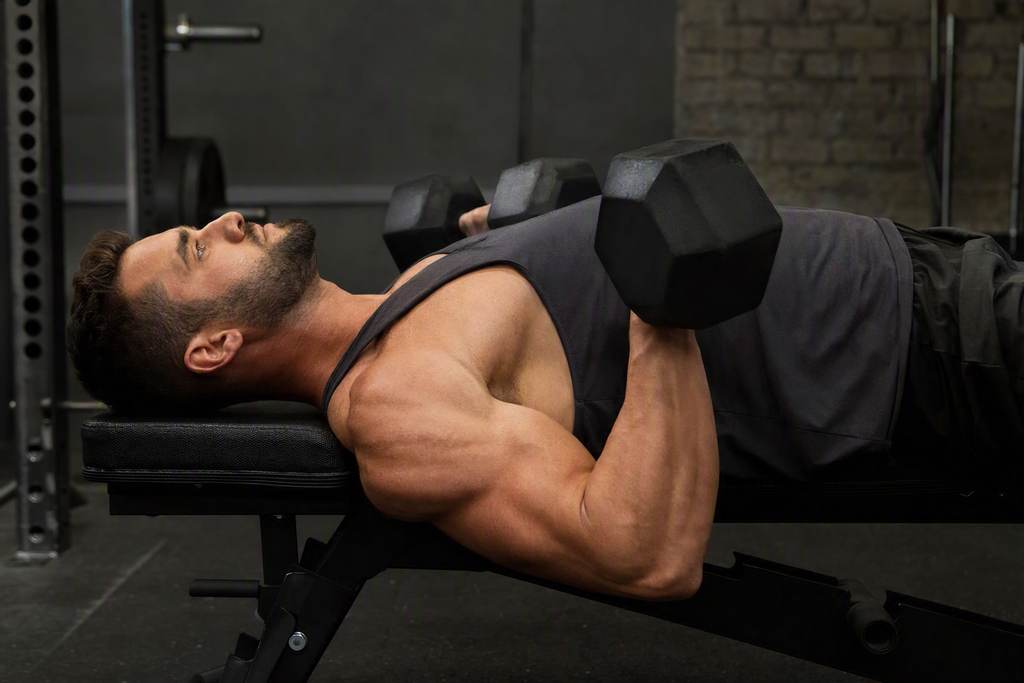
Conversely, dumbbell pressing eliminates rigid structural support. Each arm operates independently, forcing the rotator cuff musculature and anterior deltoids to fire rapidly to prevent joint drift. Because the weights are separate, your hands can converge at the top of the rep. This adduction matches the natural fibers of the chest muscle, improving inner-chest muscular sensation without excessive shoulder impingement.
Additionally, dumbbells descend past the torso plane. Without a rigid bar stopping against the sternum, you achieve a deeper stretch under load at the bottom position, a key driver for tension-mediated hypertrophy.
- 10 exercise rows with 4 sets each
- Notes column for each exercise
- Session check for warm-up, form, energy and sleep
Instant download • 100% free • No email required
Progression Speed and Progressive Overload Dynamics
Progressive overload is the fundamental driver of muscle adaptation. In a barbell program, adding weight is predictable and small micro-adjustments are simple. Standard micro-plates allow increases as small as 1 to 2.5 pounds per session. This precise control makes long-term strength progression linear and sustainable over extended training cycles.
Dumbbell progression moves in larger jumps. Moving from 50-pound dumbbells to 55-pound dumbbells represents a 10-pound total jump (a 10% increase), which often leads to technical breakdown or stalled progression. Investing in a reliable adjustable dumbbell set helps bridge training gaps for home lifters who need smaller weight jumps between setup sets.
Barbell Pros & Cons
- Pro: Higher absolute strength loading potential.
- Pro: Incremental micro-loading is easier.
- Con: Fixed barbell plane can stress sensitive shoulders.
- Con: Dominant side can compensate for weaker side.
Dumbbell Pros & Cons
- Pro: Independent limb control fixes muscle imbalances.
- Pro: Custom wrist angles relieve joint strain.
- Con: Setup and kick-up onto bench consumes energy.
- Con: Progression jumps between bell weights can be steep.
Skip If: Avoid heavy un-spotted barbell presses if you train alone without safety arms. Skip heavy dumbbell presses if severe grip or wrist instability prevents safe setup.
Trainer Execution Guide: Neutral-Grip Dumbbell Bench Press Steps
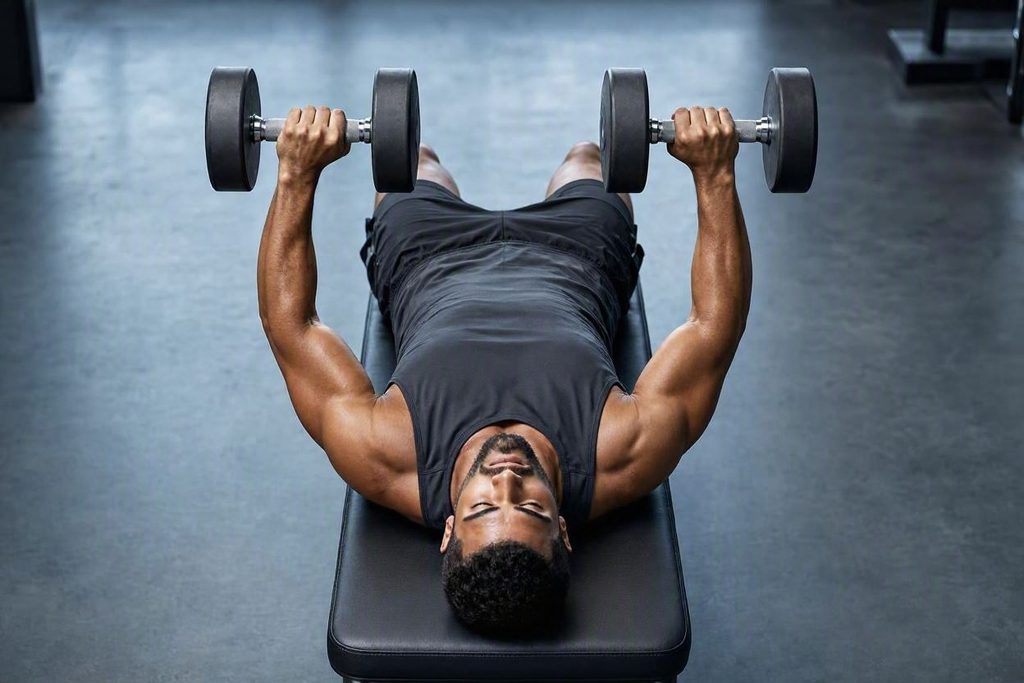
To maximize hypertrophy while protecting the glenohumeral joint, execute the dumbbell bench press with strict form and total control throughout both eccentric and concentric phases.
Step-by-Step Movement Guide:
- Sit on the edge of a flat bench with a dumbbell resting upright on each thigh.
- Kick your knees up one at a time to drive the dumbbells back as you lie flat, setting shoulders back and down into the bench pad.
- Plant your feet firmly into the floor, creating a stable arch in your upper back while holding dumbbells at chest level at a 45-degree angle.
- Press the weights vertically over your lower chest, fully extending your arms without unlocking your scapulae.
- Lower the dumbbells under strict control over 2 to 3 seconds until you feel a comfortable stretch in your chest, keeping elbows slightly tucked.
Bottom Line
- Neither variation completely eliminates the need for the other; smart periodization utilizes both.
- Use the barbell press early in workouts for high-load low-rep strength sets.
- Follow up with dumbbell presses in moderate rep ranges (8–12 reps) to focus on volume, stretch, and symmetrical muscular fatigue.
Frequently Asked Questions
Which builds a bigger chest, barbell or dumbbell bench press?
Dumbbells often provide superior chest hypertrophy for many lifters due to increased range of motion, deeper bottom stretch, and freedom to adduct hands at the top. However, barbells build overall upper-body thickness by enabling heavier absolute load exposure over time.
Can I replace barbell bench press entirely with dumbbells?
Yes. You can build exceptional chest size and functional pressing strength using exclusively dumbbells. Lifters with shoulder issues or limited space frequently rely solely on dumbbell press variations with great success.
Why is my dumbbell bench press so much lower than my barbell press?
It is completely normal to lift less weight combined with dumbbells. Your body must work hard to stabilize two separate weight masses without the fixed mechanical leverage of a solid steel bar. Typically, your total dumbbell weight equals about 75% to 80% of your barbell working weight.
How do I safely drop heavy dumbbells when training alone?
If you reach failure on a dumbbell press, bring the dumbbells down toward your chest, drop your knees up to meet them, and allow the momentum to rock you forward into a seated position. Alternatively, guide them down to thick rubber floor mats at your sides with controlled hip positioning.
Is the dumbbell bench press safer for shoulders?
Generally, yes. Dumbbells allow your wrists, forearms, and elbows to rotate into a natural neutral or semi-pronated path. This freedom reduces joint impingement risks compared to the fixed hand orientation required by a rigid barbell.
- 10 exercise rows with 4 sets each
- Notes column for each exercise
- Session check for warm-up, form, energy and sleep
Instant download • 100% free • No email required