


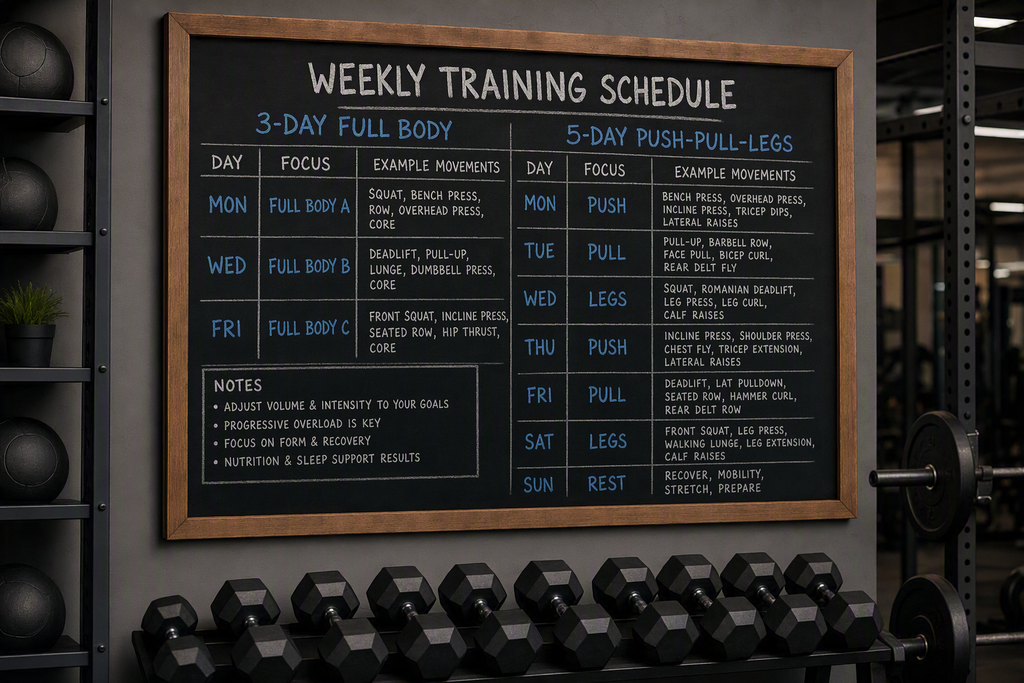
A 3 day vs 5 day workout split comparison usually comes down to three crucial variables: systemic recovery capacity, weekly adherence, and total training volume. A 3-day split (typically full-body or upper/lower/full) maximizes joint recovery and fits demanding work schedules while maintaining high training intensity per session. Conversely, a 5-day split (such as Push/Pull/Legs/Upper/Lower) allows higher total weekly volume distributed over shorter daily sessions, reducing intra-workout fatigue. Neither frequency is inherently superior for muscle hypertrophy or strength gains when weekly volume and intensity are matched. Beginners and busy professionals generally thrive on a 3-day schedule due to superior consistency, whereas experienced lifters with optimized sleep and nutrition can leverage a 5-day routine to target specific muscle groups with higher focused volume.
Quick Summary
- 3-Day Split: Best for busy schedules, joint longevity, and consistent weekly adherence with full-body stimulus.
- 5-Day Split: Ideal for lifters seeking higher total weekly volume, targeted muscle specialization, and shorter daily workouts.
- Key Takeaway: Total weekly hard sets near proximity to fatigue drive progress far more than weekly frequency alone.
Narrow Scope Declaration for Weekly Training Splits
This comparison focuses strictly on resistance training routines for drug-free adult lifters seeking muscle growth, functional strength, and long-term joint health. It evaluates how training frequency impacts neuromuscular recovery, connective tissue adaptation, and lifestyle sustainability. This analysis excludes competitive powerlifting peak cycles, elite athletic sport-specific conditioning, and high-frequency endurance preparation.
Primary Evaluation Criteria: Recovery, Adherence, and Volume
When selecting a weekly workout structure, evaluated programming must align with real-world constraints rather than idealized gym scenarios. Three core mechanics govern your success over a 12-to-16 week training block:
- Systemic Recovery: Central Nervous System (CNS) and connective tissue adaptation require dedicated rest windows between heavy mechanical tension sessions.
- Weekly Adherence: A program only yields results if completed consistently. Missed sessions on tight 5-day splits compound quickly and compromise overall balance.
- Effective Volume: The total number of hard sets per muscle group performed within 1 to 3 reps of muscular failure per week.
3 Day vs 5 Day Workout Split: Direct Comparison
In a 3-day split, exercises are organized to recruit multiple large muscle groups in a single workout. Sessions usually run 60 to 75 minutes because compound movements like squats, deadlifts, and presses require longer warm-up periods and rest intervals. In contrast, a 5-day split isolates fewer muscle groups per day, dropping daily session length to roughly 45 to 60 minutes while increasing weekly session frequency.
Key Takeaways
- 3-day routines provide 4 full rest days per week, significantly lowering chronic joint strain and cortisol elevation.
- 5-day routines distribute volume into shorter, higher-energy sessions, preventing late-workout effort decay.
- Adherence rates drop rapidly on 5-day splits when unpredictable work schedules disrupt gym attendance.
| Factor | 3-Day Workout Split | 5-Day Workout Split |
|---|---|---|
| Weekly Time Commitment | 3 to 4.5 hours total (60-90 min/session) | 3.75 to 5 hours total (45-60 min/session) |
| Full Rest Days | 4 full days per week | 2 full days per week |
| Volume per Muscle Group | Moderate (6-10 hard sets/week) | High (12-18 hard sets/week) |
| Systemic Joint Stress | Lower overall joint impact | Higher frequency; requires deliberate load management |
Pros
- 3-Day: High schedule flexibility and maximum recovery between workouts.
- 5-Day: Shorter individual workouts with high energy per movement.
Cons
- 3-Day: Longer daily training times and higher late-session mental fatigue.
- 5-Day: High risk of missed workouts causing unbalanced muscle development.
Skip If: You have unlimited personal schedule flexibility, recover rapidly, and require high weekly isolated muscle volume for competitive physique goals.
Investing in a reliable adjustable dumbbell set allows home lifters to execute both compound multi-joint movements and isolated accessory lifts effectively regardless of your chosen split frequency.
- 10 exercise rows with 4 sets each
- Notes column for each exercise
- Session check for warm-up, form, energy and sleep
Instant download • 100% free • No email required
Suitability Filter: Matching Split Frequency to Lifestyle
Choosing between these two schedules requires an honest assessment of your personal lifestyle constraints rather than emotional preference.
Who Should Select a 3-Day Split?
A 3-day routine (e.g., Monday/Wednesday/Friday) is the superior choice if you have a demanding career, long commute, or fluctuating personal responsibilities. Because you train every other day, missing a single session can easily be shifted to the following day without ruining the entire weekly structure. Additionally, lifters over age 35 or those with previous joint irritation benefit immensely from the mandatory 48-hour systemic recovery period between workouts.
Who Should Select a 5-Day Split?
A 5-day routine (e.g., Monday through Friday with weekends off) fits lifters who prefer short, intense daily gym habits before or after work. If you find your concentration or physical strength drops off severely after 45 minutes of lifting, splitting your volume across 5 shorter sessions keeps workout quality high from start to finish. However, this demands strict sleep hygiene, structured caloric intake, and zero tolerance for unexpected schedule conflicts.
Biomechanics, Recovery Protocols, and Form Safety
As training frequency increases, movement quality must remain paramount. Higher frequency routines repeat joint angles more often, increasing susceptibility to overuse injuries in the rotators, elbows, and patellar tendons.

To maintain structural balance across either split, prioritize compound movements that recruit stabilizing muscles. Execute squatting, hinge, pushing, and pulling patterns with controlled tempo (2 to 3 seconds on the lowering phase) rather than relying on explosive momentum. This maximizes tension on target muscle fibers while sparing delicate joint structures.

Final Decision Framing: How to Choose Your Training Schedule
To settle your 3 day vs 5 day workout split decision, evaluate your calendar over the past six months rather than planning based on an ideal week. If you consistently struggle to find time for 4 or 5 gym visits during busy work cycles, locking in a 3-day full-body or upper/lower routine will deliver vastly superior long-term progress due to unbroken adherence.
Conversely, if gym attendance serves as your daily stress-relief habit and your calendar reliably allows 5 days of structured time, a 5-day split allows you to specialize on weak points with higher total set volume.
Bottom Line
- Select a 3-day split if weekly adherence, joint longevity, and lifestyle flexibility drive your training choices.
- Select a 5-day split if you thrive on short daily gym sessions, recover quickly, and can guarantee consistent weekly attendance.
Frequently Asked Questions
Can you build equal muscle on a 3-day split compared to a 5-day split?
Yes. Research demonstrates that when total weekly volume (hard sets per muscle group) and proximity to fatigue are equalized, muscle hypertrophy rates are virtually identical between 3-day and 5-day training routines.
Is a 3-day split better for beginners?
A 3-day split is generally ideal for beginners because it allows high movement practice frequency while providing ample rest for adapting connective tissues and central nervous system pathways.
How long should workouts last on a 3-day split?
Workouts on a 3-day split typically last 60 to 75 minutes because they cover full-body or multi-joint compound movement patterns requiring thorough warm-ups and adequate rest periods between heavy sets.
What happens if I miss a day on a 5-day split?
Missing a day on a 5-day split can create a cascading delay in your routine, pushing subsequent muscle groups out of alignment or forcing you to combine body parts, which dramatically increases workout length and fatigue.
How many rest days do I need on a 5-day split?
A standard 5-day split incorporates 2 full rest days per week, usually taken consecutively on weekends or split evenly (e.g., rest on Wednesday and Sunday) to manage systemic fatigue accumulation.
Which split is better for fat loss during a calorie deficit?
A 3-day split is often advantageous during a calorie deficit because reduced energy intake impairs recovery capacity. The extra full rest days help preserve lean muscle tissue while keeping systemic stress manageable.
- 10 exercise rows with 4 sets each
- Notes column for each exercise
- Session check for warm-up, form, energy and sleep
Instant download • 100% free • No email required